
Where to See a Total Solar Eclipse in Reykjavík: The 12 August 2026 Guide
Reykjavík was one of the very few capital cities inside the path of totality for the total solar eclipse of Wednesday 12 August 2026. This guide, written before the event, explains how to watch a total eclipse from the city itself, no long drive required.
This eclipse has passed. The total solar eclipse crossed Reykjavík on Wednesday 12 August 2026. We have kept this guide online as a record of how to watch an eclipse from the city. For sky events you can still plan a trip around, see our northern lights guide and our Reykjavík city guides.
On Wednesday, 12 August 2026, Reykjavík will experience one of nature’s rarest events: a total solar eclipse. The partial eclipse begins at approximately 16:47, totality starts at about 17:48, and the Sun remains completely covered for roughly 58 seconds. The partial phase ends at approximately 18:47.
Iceland remains on GMT throughout the year, so no daylight-saving conversion is needed. Exact times may vary by a few seconds depending on your position in the city. You can review detailed local eclipse calculations through Time and Date’s Reykjavík eclipse guide.
Many eclipse guides recommend driving to the Westfjords or western Snæfellsnes to gain another minute of totality. Those destinations are excellent for travellers building an entire trip around the eclipse, but they are not the only sensible options.
Reykjavík sits inside the path of totality, making it possible to witness the complete eclipse without committing to a long and potentially crowded journey across Iceland.
This guide takes a Reykjavík-first approach. It explains where to watch in the city, how early to arrive, what the eclipse will look like and how to keep a rental car in Reykjavík available in case the cloud forecast favours the Reykjanes Peninsula.
Reykjavík solar eclipse times at a glance
| Eclipse phase | Approximate Reykjavík time |
|---|---|
| Partial eclipse begins | 16:47 |
| Totality begins | 17:48 |
| Maximum eclipse | Around 17:48:43 |
| Totality ends | 17:49 |
| Partial eclipse ends | 18:47 |
| Duration of totality | About 58 seconds |
Times are approximate and should be checked against official updates closer to 12 August 2026.
Reykjavík is inside the path of totality
A partial eclipse is impressive, but totality is an entirely different experience. For almost one minute in Reykjavík, the Moon will completely cover the bright surface of the Sun.
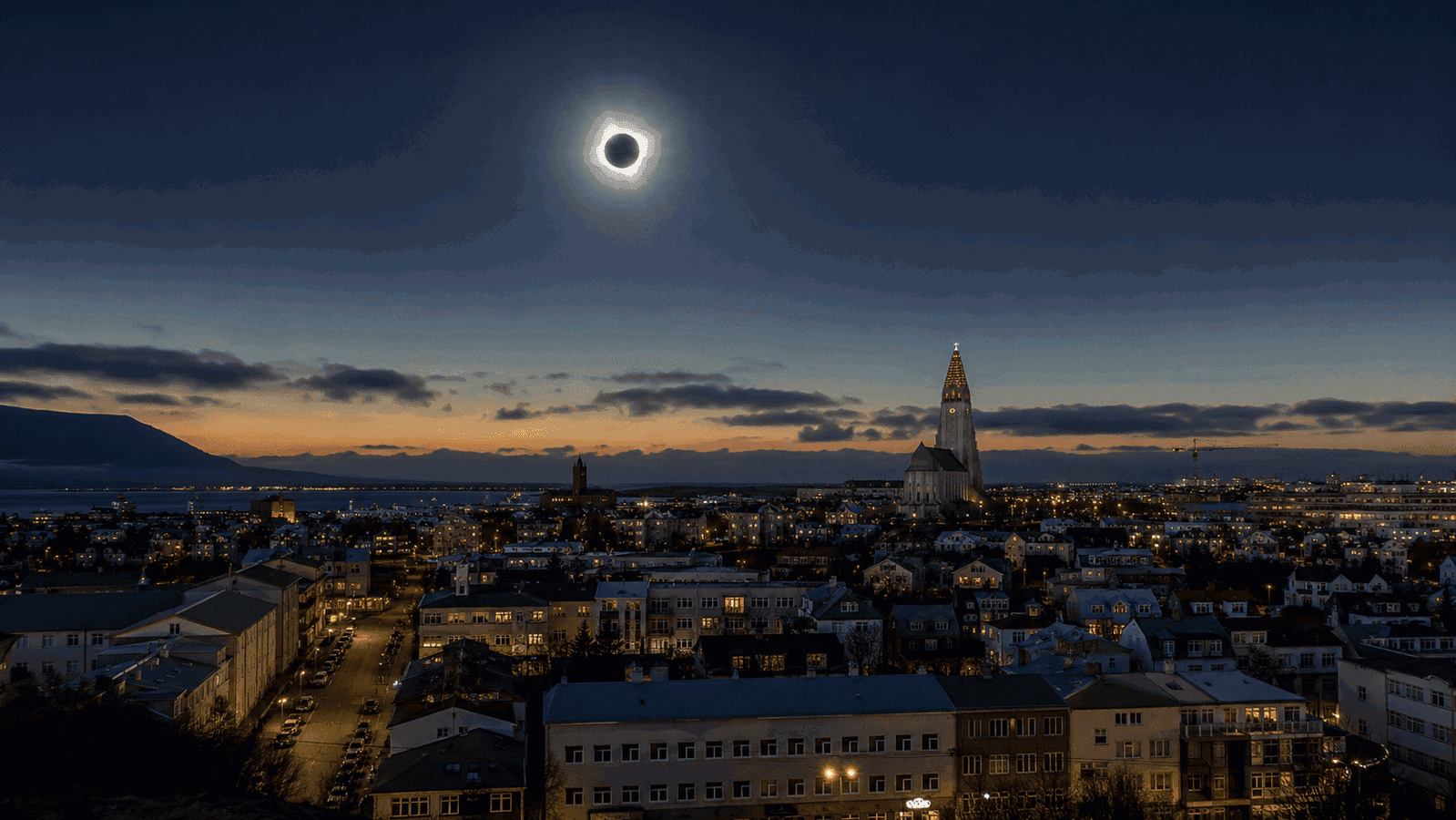
Daylight will fade rapidly into an unusual twilight. The temperature may fall, the horizon may glow in several directions and bright planets or stars may become visible. Around the black disc of the Moon, you may see the Sun’s pale outer atmosphere, known as the corona.
It is remarkably rare for a capital city to lie inside the path of totality. The 2026 event will be the first total solar eclipse visible from Iceland since 1954 and the only total solar eclipse visible from the country during the 21st century.
Reykjavík gives visitors the opportunity to experience full totality while remaining close to accommodation, food, transport and city facilities.
The most important viewing requirement: an open western horizon
During totality, the Sun will sit relatively low in the western sky, approximately 24 to 25 degrees above the horizon.
It will not be directly overhead, so your viewing location matters. Buildings, trees, hills and other obstacles can block the eclipse even when the sky above you appears clear.
Look for a location with:
- A broad, unobstructed view toward the west or west-southwest
- As few tall buildings and trees as possible
- Safe pedestrian access
- Proper parking if you are driving
- Enough space to stand without blocking roads or paths
The Reykjavík coastline is particularly well suited because several areas look directly out over Faxaflói Bay.
The best places to watch the eclipse in Reykjavík
1. Grótta and the Seltjarnarnes coastline
Best overall Reykjavík viewing area
Grótta sits on the northwestern edge of the capital area and offers one of Reykjavík’s widest coastal horizons. From the Seltjarnarnes shoreline, the view opens across Faxaflói Bay with very little land or urban development blocking the western sky.
It is likely to be one of the most popular eclipse-viewing areas in the city, so do not expect to arrive shortly before totality and find convenient parking. Walking or cycling from accommodation in western Reykjavík may be easier than driving directly to the lighthouse area.
The lighthouse itself stands on a tidal island connected by a narrow causeway. Do not cross without checking local access restrictions and the official Icelandic tide tables.
You do not need to reach the island to see the eclipse. The mainland shoreline already provides an excellent view.
2. The Ægisíða shoreline
Best for visitors staying near central or western Reykjavík
The coastal path along Ægisíða in Vesturbær has an open view across the sea toward the southwest and west. It is closer to the centre than Grótta and can be reached on foot from many parts of western Reykjavík.
The shoreline extends for a considerable distance, which may allow spectators to spread out more than at a single landmark. Scout the area beforehand and choose a position with no houses, trees or other obstacles in the direction of the Sun.
3. The Eiðsgrandi and western seafront area
A practical alternative to Grótta
The shoreline between central Reykjavík and Seltjarnarnes includes several open coastal stretches. Eiðsgrandi can provide wide sea views while remaining closer to downtown than the outer edge of Grótta.
Some sections contain buildings, harbour structures or uneven sightlines, so choose the exact location carefully. The best spot will be one where the horizon opens clearly toward the west-southwest.
4. Perlan and Öskjuhlíð
Best for elevation, but scout it first
Perlan stands on Öskjuhlíð hill and offers broad views across Reykjavík. The extra elevation can be attractive, but it does not automatically make Perlan the best eclipse location.
Trees, the building itself and the shape of the hill can interrupt the relevant western sightline. Visit before eclipse day and confirm that your chosen position has a clear view approximately 25 degrees above the western horizon.
Do not assume that every side of the observation area will work equally well.
5. Other open sections of Reykjavík’s western coastline
You do not need to stand beside a famous landmark. Any safe coastal location with an unobstructed western horizon can provide a memorable view.
A quieter section of shoreline may be more comfortable than the busiest official gathering point, particularly for families with children.
Avoid narrow paths, private land, restricted harbour areas and locations where parked cars could obstruct traffic.
Reykjavík, Reykjanes, Snæfellsnes or the Westfjords?
The longest possible totality is not automatically the best plan. You need to balance eclipse duration against driving time, road capacity, parking, weather and the needs of your group.
| Location | Totality | From Reykjavík |
|---|---|---|
| Reykjavík | About 58 seconds | In the city |
| Western Reykjanes | About 1 min 35–45 sec | 45–75 minutes |
| Western Snæfellsnes | Around 2 minutes | 2.5–3 hours |
| Látrabjarg | About 2 min 13 sec | Overnight trip recommended |
The trade-off other eclipse guides often skip
Driving farther west increases the duration of totality, but it also creates more logistical risk.
The Westfjords involve long distances, narrower roads and limited local capacity. Snæfellsnes is more accessible, but eclipse traffic may make a normal driving-time estimate unrealistic. A remote viewing location can also leave you with fewer alternatives if cloud develops in the wrong place.
Cloud is the biggest uncertainty in Iceland. No location can guarantee a clear sky in August, and a longer drive does not automatically provide better weather.
For many visitors, Reykjavík offers the strongest overall balance:
- Complete totality without a long expedition
- Numerous accommodation and dining options
- Several possible coastal viewing areas
- Easier access to facilities
- The option of driving to Reykjanes if its forecast looks meaningfully better
Should you stay in Reykjavík or drive?
Stay in Reykjavík when:
- The city forecast looks reasonably clear
- You are travelling with young children
- You have limited time
- You do not want to spend most of eclipse day driving
- You are staying downtown without a vehicle
- You prefer easy access to food, toilets and accommodation
- You have a flight or another fixed commitment
Consider Reykjanes when:
- The western peninsula has a clearly better cloud forecast
- You have already selected a safe viewing location
- You can leave Reykjavík several hours before totality
- You are prepared for traffic and limited parking
- You want a somewhat longer period of totality without driving to Snæfellsnes
Consider Snæfellsnes or the Westfjords when:
- The eclipse is the central purpose of your trip
- You have accommodation arranged nearby
- You understand the road and parking limitations
- You are comfortable committing most or all of the day
- You have a backup plan for cloud
Use Reykjavík as your eclipse base
Having a rental car gives you options, but eclipse day should not become an improvised race between viewpoints.
A sensible plan is:
- Keep a rental car available in Reykjavík on 12 August.
- Select one Reykjavík viewpoint and one realistic Reykjanes alternative in advance.
- Check updated cloud forecasts during the morning.
- Continue monitoring conditions during the early afternoon.
- Make your final location decision several hours before totality.
- Leave enough time for slower traffic, full car parks and walking from your parking place.
- Once you have reached a safe viewing location, stay there.
Do not rely on changing locations during the final hour. Roads and coastal car parks may be exceptionally busy, and gaining a few extra seconds of totality is not worth unsafe driving or missing the eclipse entirely.
Visitors staying downtown can collect a rental car in central Reykjavík and keep both a city viewpoint and a Reykjanes alternative available.
Good Reykjanes alternatives from Reykjavík
If the forecast is clearly better southwest of the city, western Reykjanes provides broad coastal views and longer totality than central Reykjavík.
Garður
Garður lies on the northwestern edge of the peninsula and has open coastal views. It is one of the more accessible alternatives from Reykjavík, but expect popular waterfront areas to attract significant interest.
Sandgerði
Sandgerði faces the Atlantic on the western side of Reykjanes. The coastline provides wide horizons, although you must still choose a safe and legal place to park.
Reykjanestá and the southwest coast
The Reykjanestá area offers dramatic coastal scenery and an open ocean horizon. It is farther from Reykjavík and can be exposed to strong wind.
Parking and road capacity are limited, so this is not a location to approach casually shortly before totality.
Keflavík and Reykjanesbær
Visitors staying near Keflavík Airport can experience totality without travelling to Reykjavík.
Parts of Reykjanes will receive roughly 1 minute 35 seconds to 1 minute 45 seconds of totality, depending on the exact location.
Travellers arriving by air can read more about our Keflavík Airport car rental options.
Check the weather like a local
Icelandic weather can change quickly, and cloud cover may differ between Reykjavík, Reykjanes, Snæfellsnes and the Westfjords.
Use the Icelandic Met Office cloud-cover forecast and focus on:
- Total cloud cover
- Low cloud and fog
- Visibility
- Wind speed
- Rain
- Forecast changes between morning and afternoon
Do not make your decision from a single weather-app symbol. Compare the forecast map across several locations and check it repeatedly as eclipse day approaches.
A clearer forecast on Reykjanes can justify moving there early. A marginal difference does not justify a stressful drive through heavy traffic.
Closer to totality, also look outside. Satellite imagery, visible cloud movement and conditions on the horizon can provide useful context, but no forecast can remove all uncertainty.
When should you arrive?
The partial eclipse begins at approximately 16:47, but totality does not begin until about 17:48.
For a popular Reykjavík location, aim to be in position by 16:30 at the latest. For Grótta or any organised gathering area, arriving earlier may be wise.
An ideal city schedule would be:
| Time | Plan |
|---|---|
| Before 14:00 | Review the latest forecast and choose your final area |
| 15:00 to 16:00 | Travel toward your viewpoint |
| By 16:30 | Park safely and set up |
| Around 16:47 | Partial eclipse begins |
| Around 17:20 | Stop adjusting equipment and get ready |
| Around 17:48 | Totality begins |
| Around 17:49 | Totality ends and eye protection goes back on |
| Around 18:47 | Partial eclipse ends |
Do not time your arrival for 17:40. Parking, road closures, crowds or a short walk from your car could cause you to miss the entire period of totality.
How to watch the eclipse safely
Looking directly at the Sun during the partial phases can permanently damage your eyesight.
Use solar-viewing glasses that comply with the ISO 12312-2 standard and come from a reputable supplier. Ordinary sunglasses are not safe, regardless of how dark they appear.
Before buying glasses, review the American Astronomical Society’s eclipse eye-safety guidance and its list of suppliers of safe solar viewers.
Follow these rules:
- Wear proper eclipse glasses throughout the partial phase.
- Inspect the glasses before use and discard them if the filter is scratched, torn or damaged.
- Put the glasses on before looking toward the Sun.
- Supervise children closely.
- Do not use sunglasses, smoked glass, exposed film or a phone screen as protection.
- Do not look through binoculars, telescopes or camera viewfinders while wearing ordinary eclipse glasses.
- Optical equipment requires a correctly fitted solar filter over the front of the lens.
- Remove eye protection only when the Sun is completely covered during totality.
- Put protection back on immediately when the first bright point of sunlight reappears.
Direct naked-eye viewing is safe only during the brief period of complete totality. In Reykjavík, that period lasts approximately 58 seconds.
Where to get eclipse glasses
Do not assume that certified glasses will still be available in Reykjavík during eclipse week. Demand is likely to be high.
Buy them well before travelling and pack them in your hand luggage. Bring at least one spare pair for your group and store them where the filters will not be bent, scratched or crushed.
A printed ISO number alone does not prove that the glasses are safe. Buy from a supplier recommended by a recognised astronomy or safety organisation.
What totality will look like
The final minutes before totality are part of the experience.
As the Moon covers more of the Sun:
- Daylight becomes dimmer and less familiar
- Shadows may look unusually sharp
- The temperature may fall
- Animals and birds may react to the changing light
- The western sky darkens rapidly
Immediately before totality, the remaining sunlight may break into bright points called Baily’s beads, created as light passes through valleys along the Moon’s edge.
When the final bright point disappears, the corona becomes visible around the black silhouette of the Moon. The horizon may retain a band of light while the sky above Reykjavík resembles deep twilight.
Totality lasts less than one minute in the city. Decide beforehand whether your priority is to photograph it or experience it directly. Trying to reorganise equipment after totality begins will consume much of the event.
How to photograph the eclipse without missing it
Eclipse photography requires more preparation than pointing a phone at the Sun.
During the partial phases:
- Use a suitable solar filter over the front of the camera lens.
- Keep the filter attached until totality has fully begun.
- Never look through an unfiltered optical viewfinder.
- Set up and practise before eclipse day.
- Use a stable tripod where it can be placed safely.
- Turn off the flash.
- Avoid relying on digital zoom.
- Test focus and exposure in advance.
During complete totality, the solar filter can be removed to photograph the corona. It must be replaced as soon as the bright surface of the Sun begins to return.
For phone photography, keep expectations realistic. A phone may record the atmosphere, darkened landscape and reactions of the people around you more successfully than a detailed close-up of the corona.
Set the phone running before totality, take a few photographs, then look away from the screen. You only get approximately 58 seconds.
Plan for crowds, parking and limited facilities
Popular coastal locations may fill several hours before the eclipse. Do not assume that parking, toilets, food or charging facilities will be readily available beside your chosen viewpoint.
Bring:
- Eclipse glasses and a spare pair
- Warm and waterproof layers
- Water and snacks
- Necessary medication
- A fully charged phone
- A portable power bank
- A downloaded map or offline route
- A blanket or portable seat if appropriate
Even in August, the Reykjavík coast can feel cold in wind. Dress for standing still beside the sea rather than for walking around the city.
If you are driving an electric vehicle, begin the day with enough range to reach your viewing location and return without relying on a busy public charger.
Driving and parking safely on eclipse day
Never stop on a road, roundabout, bridge, hard shoulder or private driveway to watch the eclipse.
Use an established car park or a clearly legal pull-off. Keep emergency access routes open and follow instructions from police, landowners and event staff.
Expect:
- Slower traffic
- Full coastal car parks
- Temporary traffic management
- Longer walking distances
- Pedestrians near roads
- Limited opportunities to change locations
If a car park is full, continue safely. Do not create a new parking space on soft ground, vegetation or the roadside.
Before driving out of Reykjavík, check current conditions through the official Icelandic road and traffic information service.
You should also review our Iceland driving safety guide before travelling outside the capital.
For city-specific information, read our guide to parking in Reykjavík.
Make a day of it in Reykjavík
Totality takes place in the late afternoon, leaving most of the day free to enjoy Reykjavík.
Have lunch early, collect anything you need and avoid booking a restaurant, tour or transfer close to eclipse time. By mid-afternoon, begin making your way toward the chosen viewing area.
Ideas for the hours before the eclipse include:
- Walking around Reykjavík’s old harbour
- Visiting Hallgrímskirkja
- Exploring the city centre
- Visiting a swimming pool
- Having an early meal
- Walking part of the coastal path
- Visiting Perlan before continuing to a confirmed viewing location
See our guides to sightseeing in Reykjavík and spending 48 hours in Reykjavík for more ideas.
Getting a rental car in Reykjavík for eclipse day
Reykjavik Rent A Car is based in central Reykjavík, allowing visitors staying downtown to collect a car without first travelling to Keflavík Airport.
See our downtown pickup location before eclipse day and plan how you will reach the office.
A rental car can be useful if you want to:
- Reach Grótta or another coastal viewpoint
- Carry warm clothing, food and photography equipment
- Keep a Reykjanes alternative available
- Continue travelling after the eclipse
- Avoid building your entire Iceland itinerary around one remote location
Our after-hours keybox provides additional flexibility for eligible pickups. Online check-in must be completed in time for an arranged keybox collection, so do not leave the process until eclipse afternoon.
Partner pickup near Keflavík Airport is also available. Keflavík lies inside the path of totality, meaning travellers based near the airport can watch the complete eclipse without travelling into Reykjavík.
You can compare our rental cars before selecting the most suitable option for your plans.
For a Reykjavík-based eclipse day, a small rental car or medium-sized car should be sufficient for normal paved-road travel. A 4x4 is not required simply to reach Reykjavík or the main towns on Reykjanes.
Our rental price includes the applicable base protection, and additional insurance packages can be selected during booking. Platinum insurance reduces the excess to 0 ISK.
Read more about our car rental insurance options before choosing your package:
CDW Insurance
Excess: 350.000 ISK
You are responsible for damages up to this amount.
Includes:
- Collision Damage Waiver (CDW)
- Personal Accident Insurance (PAI)
- Third-party Liability Insurance (TPI)
Platinum Insurance
Excess: 0 ISK
Full protection for your trip.
Everything included in CDW Insurance, plus:
- Tire Protection
- Windshield Protection (WP)
- Water and Undercarriage Protection
- Theft Protection (THP)
- Gravel Protection (GP)
- Sand and Ash Protection (SAAP)
Check availability for eclipse week:
A simple Reykjavík eclipse plan
For most visitors, this is the plan we recommend:
- Stay in Reykjavík and keep 12 August free of rigid afternoon commitments.
- Collect certified eclipse glasses well before travelling.
- Choose Grótta, Ægisíða or another open western shoreline as your city option.
- Identify one realistic Reykjanes alternative.
- Review the forecast repeatedly on eclipse morning and early afternoon.
- Commit to your location several hours before totality.
- Arrive early and park legally.
- Put your phone down for at least part of totality.
- Do not leave immediately with everyone else unless necessary.
- Remember that one clear minute in Reykjavík is worth more than two minutes hidden behind cloud somewhere farther away.
Final advice
You do not need to drive to the edge of Iceland to experience the 2026 total solar eclipse.
A clear western horizon in Reykjavík, proper eclipse glasses and an early arrival are enough to witness totality. Keeping a rental car nearby adds flexibility, particularly if the Reykjanes forecast looks considerably better, but the goal is not to spend eclipse day chasing every possible extra second.
Choose a safe location. Arrive early. Prepare your equipment.
Then, when Reykjavík falls into twilight at about 17:48, stop looking at the clock and watch.